
Our latest MTMS recital playlist is ready! Take some time to enjoy performances from our students. Help us celebrate all the work they put into preparing and recording their music. We are proud of everyone who participated, and we hope you enjoy the show!
Category: Breaking News
-
Finding the Beat: Our Students Explore Drum Corps
Fast, Loud, and Perfectly in Sync: What Students Noticed About Drum Corps
Our students explored the exciting world of drum corps during this month’s Music Lab theme. They listened, watched, and learned about the different sections that bring a performance together.
One observation appeared again and again: these musicians play fast!
However, speed was only part of what caught our students’ attention. They also noticed precision, movement, different sounds, and impressive teamwork.
Everyone Has to Work Together
Isaac summed up one of the biggest challenges of drum corps performances. Everyone has to be “in perfect sync.”
Other students noticed the same thing.
Jaylin thought the performers showed “nice coordination with each other.” Liam noticed that musicians played at exactly the same time. Meanwhile, Mikayla focused on how important the beat was.
She noticed that the musicians did more than play on beat. Their movements also matched the music.
That coordination becomes even more impressive when performers create formations on the field. Beatrice and Sebastian both noticed musicians making shapes while they played.
“There’s a lot of people on the field,” Beatrice observed. “They make shapes while playing instruments. I think that’s cool.”
How Many Sounds Can Drums Make?
Several students were surprised by the variety of sounds percussion instruments could produce.
Isaac heard “lots of different tones and sounds even though it’s only percussion.” Wynn discovered that striking a drum in different places can create different sounds.
Ben even noticed performers hitting the rims of their drums.
Meanwhile, Paisley identified snares, cymbals, and a large drum with a deep sound.
All those sounds serve different purposes. Snares can handle incredibly quick rhythms. Tenor players use multiple drums to create different pitches and patterns. Bass drums divide parts among several musicians.
The front ensemble, often called the pit, adds even more possibilities. It can include keyboards and other percussion instruments that contribute melody, harmony, rhythm, and special effects.
Different Jobs, One Drum Corps
Students also learned to recognize the different percussion sections.
Sebastian identified the tenor, snare, and bass lines. He also noticed that the pit remains separate from the marching drumline.
Graham made a similar discovery. While many musicians march, front ensemble performers usually stay in one place.
Beatrice learned about multi-tenor setups. These allow one musician to play several drums of different sizes. Smaller auxiliary drums can add higher sounds and help create fast, intricate patterns.
Students also discovered that marching percussion equipment has changed over time. Ellie learned that musicians once carried drums differently. Modern harnesses now position marching drums in front of the performer.
Playing Fast—and Moving Fast
Speed became one of the most common observations of the month.
Nevaan called the music fast. Isabella noticed very fast playing. Liam saw musicians playing and marching quickly at the same time.
Aiden put it even more enthusiastically: “They play insanely fast.”
He was particularly impressed by the Bluecoats.
Yet playing quickly is not enough. Every musician has to control the rhythm, dynamics, technique, and timing. Marching performers must do all of that while moving precisely around a field.
No wonder so many students focused on coordination.
More Than Just Drums
Although percussion took center stage during our exploration, students spotted other parts of drum corps performances too.
Elliana heard trumpets and noticed the football field setting. Jaylin heard cheering in the background of one performance. Beatrice even noticed performers using vocal sounds such as “hey” or “ho.”
Drum corps performances combine music, movement, visual design, and theatrical elements. Each section contributes something different to the finished production.
Perhaps that explains why our students noticed so many details.
Some listened for individual instruments. Others watched the performers move. A few focused on speed or rhythm. Still others noticed how musicians created different sounds from similar instruments.
Together, their observations revealed the same thing the performers demonstrate on the field: many individual parts can become something much bigger when everyone works together.
-
Epic Stories, Legendary Albums: Exploring Rock Opera
What Is a Rock Opera?
Some songs tell a story. A rock opera tells an entire story through music.
Instead of following a traditional stage musical, a rock opera unfolds through a collection of connected songs. Each track moves the plot forward, develops characters, or explores emotions. The result feels more like reading a novel than listening to a playlist.
Our Music Lab theme this month explores some of the most influential rock operas ever created. You’ll hear unforgettable music while discovering how artists use storytelling to create something much bigger than a single hit song.
The Album That Changed Everything
One of the most influential rock operas is Tommy by The Who.
Released in 1969, Tommy follows the life of a boy who becomes deaf, blind, and mute after witnessing a traumatic event. The story explores isolation, faith, fame, and healing through a continuous musical narrative.
The album became a cultural phenomenon. It later inspired a film, a Broadway production, and countless artists who wanted to tell larger stories through rock music.
Without Tommy, many later concept albums might never have existed.
One Song That Feels Like an Entire Story
Not every rock opera spans a full album.
Queen’s “Bohemian Rhapsody” tells an emotional and mysterious story in just under six minutes. The song blends rock, opera, ballad, and hard rock into one unforgettable performance.
Its shifting moods and dramatic characters invite listeners to create their own interpretations. Decades after its release, fans still debate exactly what the lyrics mean.
Sometimes one song can feel as expansive as an entire musical.
Twenty Years of The Black Parade
This year marks twenty years since My Chemical Romance released The Black Parade.
The album follows a dying character known as “The Patient” as he reflects on life, death, fear, and memories. Each song reveals another chapter of his journey.
The record blends theatrical performances with powerful rock music. Its dramatic style introduced many younger listeners to the idea of a modern rock opera.
Even after two decades, songs like “Welcome to the Black Parade” continue to inspire fans around the world.
Why Rock Operas Matter
Rock operas challenge musicians to think beyond individual songs.
Artists must create memorable melodies while developing characters, themes, and a complete storyline. Listeners experience music differently because every track builds on what came before.
These albums also reward repeat listening. Each time you return, you may notice a new lyric, musical connection, or plot detail.
What Will Students Discover?
This month, students will listen for recurring musical ideas, character development, and storytelling techniques. They’ll compare different rock operas and discover how artists connect songs into a larger narrative.
Whether you already know Tommy, love “Bohemian Rhapsody,” or have recently discovered The Black Parade, you’ll hear these works with fresh ears.
Rock operas remind us that music can entertain, challenge, and tell unforgettable stories—all at the same time.
The tradition of musical storytelling didn’t end with classic rock. Modern artists continue to build rich fictional worlds through connected albums, films, and recurring characters. Melanie Martinez’s recent work shows how the idea behind the rock opera has evolved. Today’s artists often tell their stories across multiple albums and visual media, proving that audiences still love following unforgettable characters through music.
-
Why Learning Music Is Like Learning a New Language
Have you ever heard someone say that music is a language? It turns out there is a lot of truth behind that idea.
Like any language, music has its own symbols, patterns, vocabulary, and rules. At first, everything feels unfamiliar. However, with practice and guidance, those symbols begin to make sense. Eventually, they become second nature.
Let’s look at a few ways music and language learning are surprisingly similar.
You Start with the Basics
Children do not begin reading novels on the first day they learn English. Instead, they learn letters, sounds, and simple words.
Music works the same way.
Students first learn note names, rhythms, and basic techniques. Then, they combine those skills into short songs. Over time, they perform longer and more challenging pieces.
Every new concept builds on the last one.
Reading Music Is Like Learning to Read
When children learn to read, they stop sounding out every letter. Eventually, they recognize whole words at a glance.
Music students experience the same process.
At first, they identify notes one by one. Later, they recognize familiar rhythms, intervals, chords, and musical patterns without stopping to think about each symbol.
As a result, reading music becomes faster and more natural.
Listening Comes Before Speaking
Babies spend months listening before they say their first words.
Likewise, musicians spend time listening before they perform confidently.
Students hear steady rhythms, matching pitches, expressive dynamics, and musical phrases. As they listen more carefully, they begin to recreate those sounds with greater accuracy.
Listening is one of the most valuable musical skills a student can develop.
Practice Builds Fluency
Nobody becomes fluent in a new language after one lesson. The same is true for music.
Instead, students improve through regular practice. Each lesson adds another piece to the puzzle.
Some weeks bring noticeable breakthroughs. Other weeks focus on steady progress. Both are important parts of learning.
Over time, students stop thinking about every note or rhythm. Instead, they focus on making music.
Mistakes Help You Learn
Every language learner mispronounces words. Those mistakes are part of the learning process.
Music students also miss notes, lose their place, or struggle with a rhythm. Although those moments can feel frustrating, they provide valuable feedback.
Each correction helps students understand the music more deeply. Consequently, mistakes become stepping stones instead of roadblocks.
Music Helps You Express Yourself
Learning vocabulary is not the final goal of language. Communication is.
The same idea applies to music.
Notes and rhythms are tools for expressing thoughts, feelings, and creativity. Whether students perform a favorite song, improvise a solo, or compose original music, they use music to communicate something meaningful.
That ability grows stronger with experience.
Every Musician Has an Accent
People speak with different accents, even when they use the same language.
Musicians also develop their own musical “voice.”
Two pianists can perform the same piece differently. Likewise, two singers can bring different emotions to the same song. Those differences make music personal and memorable.
Learning the fundamentals gives students the freedom to develop their own style.
The Music Technology & Learning Lab Builds Fluency
At Michelle Tuesday Music School, students do more than learn songs.
Each week, students spend time with their private teacher and in our Music Technology & Learning Lab. There, they strengthen music theory, rhythm, ear training, listening skills, and composition through interactive activities and technology.
These skills work together much like reading, writing, listening, and speaking in a language class. As a result, students build confidence while becoming well-rounded musicians.
Every Lesson Adds a New Word
Learning music does not happen overnight. Neither does learning a language.
Instead, students make steady progress through small, consistent steps. One new rhythm leads to another. One new chord unlocks another song. One successful lesson builds confidence for the next challenge.
Before long, students realize they are no longer translating every note. They are simply making music.
That is when music begins to feel less like a subject to study and more like a language they can truly speak.
-
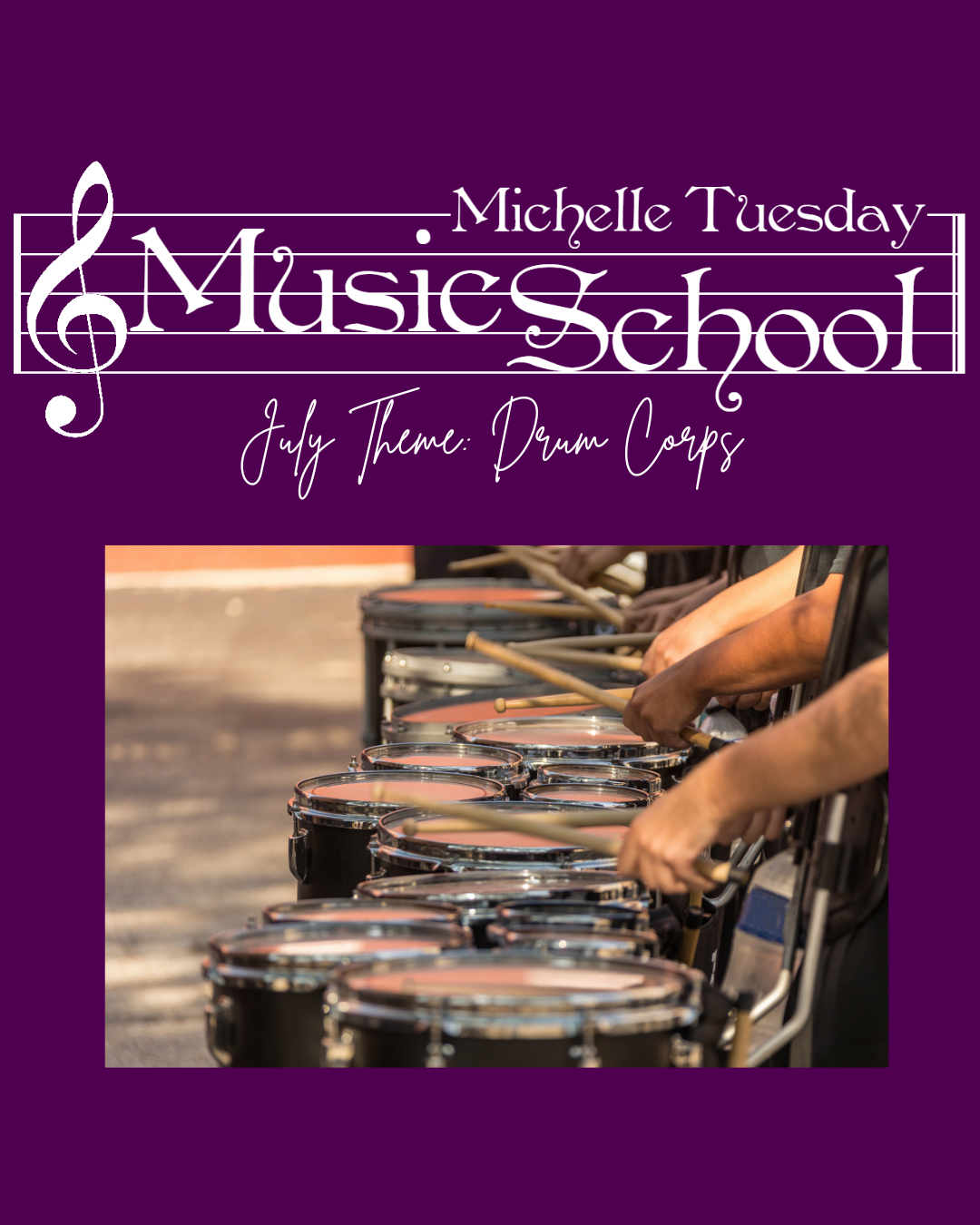
Drum Lines: The Heartbeat of the Ensemble
Whether you’re hearing the thunder of a bass drum line, the intricate movement of tenor drums, or the unmistakable crack of a well-tuned snare, drum lines bring unmatched energy and precision to any performance. This month’s theme explores several key aspects of percussion writing and performance, from arranging for different sections of the battery to understanding the unique sound of percussion-only drum corps ensembles.
Writing for the Tenor Line
Tenor drums, often called quads or quints, provide one of the most melodic voices within the battery. Unlike the snare drum, tenor players perform across multiple drums, allowing composers to create sweeping patterns, melodic contours, and visually exciting stick movements.
When writing for tenors, think beyond simple rhythmic accompaniment. Effective parts use the different drum sizes to create tonal contrast while maintaining comfortable sticking patterns. Smooth movement around the drums not only sounds cleaner but also allows performers to execute passages with greater accuracy and confidence.
Balance technical difficulty with musical purpose. Every phrase should contribute to the overall sound of the ensemble while remaining practical for performers to play consistently during rehearsals and performances.
Building a Strong Bass Drum Line
The bass drum section serves as the rhythmic and tonal foundation of the drum line. Rather than every player performing identical rhythms, modern bass lines often divide rhythms among multiple drums. This “split part” approach creates a full rhythmic texture while highlighting each player’s contribution to the ensemble.
Successful bass drum writing considers:
- Natural hand movement and sticking.
- Logical note distribution between players.
- Consistent timing across the section.
- The tonal relationship between the different-sized drums.
When written effectively, the bass line becomes much more than a source of low-end power. It becomes a highly coordinated instrument that supports every section of the ensemble while adding its own musical character.
Tuning the Snare Drum
A great snare sound begins long before the first rehearsal. Proper tuning affects articulation, projection, and the overall character of the drum line.
Start by evenly tensioning the batter head to produce a consistent pitch around the drum. Then adjust the bottom, or snare-side, head to achieve the desired snare response. Finally, fine-tune the snare wires so they provide a crisp sound without excessive buzz.
The ideal tuning depends on the style of music. A marching ensemble may favor a bright, articulate sound with higher tension, while an indoor or concert setting may call for a warmer, more controlled tone. Regardless of the style, consistency across every snare drum helps create a unified sound.
The Power of a Drum Corps Ensemble
One of the most exciting percussion formats is a drum corps-style ensemble made up almost entirely of percussion instruments. These groups demonstrate that rhythm alone can create compelling and expressive musical performances.
A typical percussion ensemble of this style combines:
- Snare drums for precision and articulation.
- Tenor drums for melodic movement and texture.
- Bass drums for depth and rhythmic foundation.
- A front ensemble (pit) featuring marimba, xylophone, and timpani to provide harmonic color, melodic content, and expanded musical expression.
Without brass or woodwinds, every musical idea must come from the percussion section. Dynamics, phrasing, timbre, and rhythmic interplay become the primary storytelling tools. The result is a performance that is both visually engaging and musically rich, showcasing the incredible versatility of percussion.
Just as important as musical ability is the discipline required to perform as one unit. Every member of the drum corps must stay in step, maintain a steady beat, and match the timing and movement of the entire line. A single performer who falls out of step or rushes the tempo can affect the precision of the entire ensemble. The heartbeat of the group depends on every player moving and performing together.
Beyond technical precision, drum corps performances are designed to entertain. Players often incorporate visual flourishes, including stick tricks, spins, crossovers, body movements, and choreographed gestures, to engage the audience while maintaining musical accuracy. These visual elements, combined with synchronized marching and powerful percussion, create the electrifying performances that have made drum corps a favorite among audiences for generations.
Bringing It All Together
Writing for a drum line is both an art and a science. Each section has its own role, technique, and musical voice, yet every performer contributes to a single, unified sound. Understanding how to write effectively for tenor and bass drums, learning the fundamentals of snare tuning, and appreciating the precision required in a drum corps ensemble all contribute to stronger performances and more engaging compositions.
Whether you’re a student learning your first cadence, a composer arranging for marching percussion, or an educator developing young musicians, exploring these concepts will deepen your appreciation for the craftsmanship behind every great drum line. Every beat, every tuning adjustment, every synchronized step, and every visual flourish contributes to the powerful performance that keeps audiences engaged from the first note to the final cadence.