★4.9 Google rated 🎵
100+ reviews from our local Gahanna families 🎵
Serving the Gahanna community since 2010 🎵
Unlimited makeups* 🎵
Change your schedule at any time 🎵
Simple, transparent pricing 🎵
Family discounts 🎵
Neurodiversity-affirming music lessons 🎵
Two-teacher model: Music Lab + instrument 🎵
Unlimited adult Music Lab time 🎵
Year-round performance opportunities 🎵
Annual benefit concert for local food pantry 🎵
Conveniently located near Hamilton & Morse 🎵
Book a 4-week trial today!
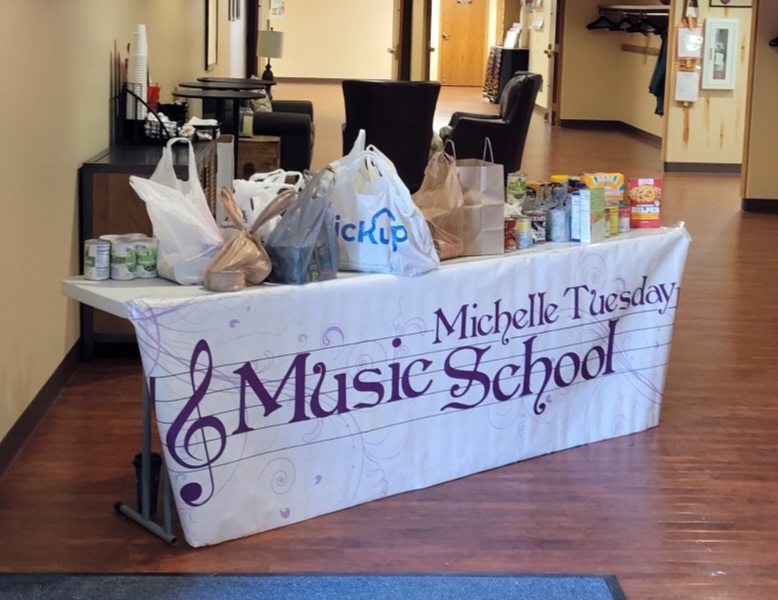
On Saturday, January 14, the MTMS Winter Benefit Concert at St. Luke’s Lutheran Church in Gahanna raised over 180 pounds of food for GRIN (Gahanna Residents in Need)!
This concert was set in two hour-long sessions. Our students delighted friends and family with their hard work and great music. MTMS is extremely proud of every student and the progress they’ve made with their music.
Did you guess a cappella? This form of music includes singing without instruments. Categories within a cappella include bass, tenor, alto, soprano, and beatbox. In the lab you’ll be asked to create your own version of an a cappella song. In music history you’ll learn a lot more information about a cappella music and how it came to be.
In the lab this week, the challenge for students is to write at least one minute in both monophony and polyphony on your own instrument or even one you’ve never played before. New words for music support people? Monophony is a single melody line. Polyphony is multiple melody lines.
There are many songs in popular music where there is a single (sung) melody line, and at a later point in the song the earlier melodies are layered together. (I’ve got We Don’t Talk About Bruno stuck in my head, but every song sung in the round starts with a monophony, turns into a polyphony, and ends in monophony. Please save me from my earworm and comment with your favorite songs that blend both of these. Adele – Rolling in the Deep and Happy – Pharrell Williams)
Have a blast in the lab with the medieval music theme. We’re looking at music styles between 500 and 1400 AD. Many common examples include Gregorian chants and church music.
The theme this month is Medieval Music! Music history and music composition will focus on the ideas that make medieval music what it once was – the longest running era of classical music. It’s also the first documented era of music and a great way to start January.
The five characteristics of medieval music are monophony, music notation, instruments, troubadours and trouvères, and rhythm/modes. Some of those are new words for me and maybe you, too. Monophony refers to one melody line, often vocals sung with or without accompaniment. Music notation, far from what we read as music today, was to show where to have the vocal melody rise or fall. Instruments included a flute (with holes, not keys), recorder, lute, dulcimer, and lyra. Troubadours are traveling musicians and trouvères are poet-musicians. Medieval music was not organized as modern music; instead, the time period used rhythmic patterns called modal scales – and there were eight of them.
As always, for our youngest students we offer new seasonal coloring pages and other age-appropriate activities.
Happy New Year! After a lovely break, we’re back at MTMS and ready to bring out new music and new instruments for anyone who wishes to learn. If it’s been on your bucket list to play music, let us know. It’s a great time to start a new habit.
Are you worried about all the comments and statistics about failed resolutions? We understand. One thing about the resolutions that our society has ingrained to try on the first of every year is that when you resolve to do a thing and you do it- your brain thinks you’re done. This is especially true when it is something that is painful like working out.
Tips from the pros vary. However, most of the successful new goals you see accomplished are either SMART goals or intentions. And either of those options have behind it tracking to see how we’re doing throughout the year. Because it is one thing to say I’m going to start a brand-new thing in 2023 and achieve it, and quite another to say I’m starting a brand-new goal and I’m going to track my progress to figure out how well I’m doing.
If you don’t know what SMART stands for: Specific, Measurable, Attainable, Relevant, Time-Bound. So instead of saying I’m going to learn to play the violin this year, I say I’m going to take lessons on the violin and practice at least three times a week for a year. This specific goal means I will find a place to take lessons (MTMS is here for me, too!), I’m going to track how often I practice, and I have a time frame I’m working with. Whether this is an attainable goal is all about how my schedule works, but it is very relevant if I want to learn violin.
The way to succeed at your goals is to take a hard look at what you do during your free time. If I’m not making my three practice times a week and I’m actually playing MarioKart for four hours and watching tv for a couple other evenings, I could look at that and say I failed to make my goal or I could adjust to say right when I get home on Monday and Thursday I’m going to practice, plus I will do it again on Saturday morning after chores.
One other thing we don’t talk about for goals – we don’t hit them every week or every month. But if I am tracking these things, and I see through the 52 weeks of the year that I made it for 50 I will call that a win. I know I had a goal I didn’t make last month because of the holidays and all the time spent with family instead of toward my goal. I don’t regret time with my family, and I will pick it up again this week. Be kind to yourself when Life Gets In The Way, but don’t let it happen every week or every month. Also be honest to keep yourself to your goals or adjust them to what is attainable. This is your goal, and the person who benefits from it is you. There isn’t a benefit to giving yourself a goal like practicing the flute for fifteen hours a week if you’ve never played before. It only seems like a good way to beat yourself up when you don’t meet it.
Happy New Year. Bring in 2023 with your best intentions and goals, and track them to see how you’re doing. Be your best you and play your music, too.