★4.9 Google rated 🎵 100+ reviews from our local Gahanna families 🎵 Serving the Gahanna community since 2010 🎵 Unlimited makeups* 🎵 Change your schedule at any time 🎵 Simple, transparent pricing 🎵 Family discounts 🎵 Neurodiversity-affirming music lessons 🎵 Two-teacher model: Music Lab + instrument 🎵 Unlimited adult Music Lab time 🎵 Year-round performance opportunities 🎵 Annual benefit concert for local food pantry 🎵 Conveniently located near Hamilton & Morse 🎵 Book a 4-week trial today!

Category: MTMS Blog Posts

  • From Jamaica to the World: Students Explore the Sound of Reggae

    From Jamaica to the World: Students Explore the Sound of Reggae

    This month, students spent time listening to and learning about reggae music. Their observations highlighted sound, mood, history, and how the music changes over time. Together, their comments paint a clear picture of a genre full of warmth, rhythm, and meaning.


    🎧 Sound, Mood, and Musical Feel

    Many students noticed the overall sound and feeling of the music right away. They described echoing voices and songs that felt happy and positive. Several mentioned that the lyrics tell a story and often focus on the world in an uplifting way. The music was also described as “very vibey,” tropical, calming, and steady.


    🎸 Instruments, Dynamics, and Tempo

    Instrumentation stood out during listening activities. Students heard lots of guitar, both acoustic and electric, along with drums and bongo drums. Some noticed high hat and staccato drum parts, while others pointed out how songs often start with one instrument and slowly add more. As instruments build, the music becomes louder and fuller.

    Dynamics and tempo were another focus. Students shared that some songs are calm, while others move faster. A few noticed that certain songs begin slowly and end with more energy. Others described the dynamics as soft and smooth.

    One song made a strong impression. A student shared that they really liked “Don’t Worry Be Happy.”


    🌍 History, Roots, and Cultural Reach

    During history discussions, students explored where reggae comes from. Many noted that reggae originated in Jamaica and began in the 1960s. They learned that reggae developed over time, starting as mento, then moving through ska and rock steady before becoming reggae.

    Bob Marley came up often in student reflections. Students shared that he is one of the most famous reggae musicians and is seen as the face of the genre. Several mentioned his name when talking about reggae’s history and influence.

    Students also learned that reggae music reaches beyond one place. While it began in Jamaica, they discovered that many other places use and play reggae music today. Along the way, they also learned that Jamaica is the third-largest island in the Caribbean.


    From tropical sounds and positive lyrics to rich history and layered rhythms, students connected deeply with reggae music. Their comments show careful listening, growing musical vocabulary, and curiosity about how music reflects culture and place.
  • Music & the Kings

    Most people know that Martin Luther King, Jr., civil rights activist and Nobel Peace Prize laureate, was born the son of a Baptist minister in Atlanta. Did you also know the musical links that connected MLK with his wife, Coretta Scott King and her family?

    The Bride

    Coretta Scott grew up in the small, segregated town of Heiberger, Alabama, where her parents owned a store. Her mother, Bernice, played piano at church. Coretta inherited her mother’s musical talent. She was the leading soprano in her high school’s senior chorus, played trumpet and piano, participated in school musicals, and directed a choir at church. She received a scholarship to Antioch College in Ohio from the Antioch Program for Interracial Education. It’s no surprise that she studied music. She also became politically active there, due to racial discrimination.

    The Groom

    Like Coretta Scott, Martin Luther King was also the child of a church piano player. He was memorizing hymns at age five and singing them in church by six. Later he developed a love for opera and sang in choir. He also took violin and piano lessons! His mother, Alberta Williams King, served as the organist at Ebenezer Baptist Church in Atlanta for forty years. King’s favorite hymns included “I Want to Be More and More Like Jesus” and “Take My Hand, Precious Lord”.

    The Courtship

    Coretta transferred from Antioch in 1951, when the New England Conservatory of Music in Boston awarded her a scholarship to study voice. That’s where she met Martin Luther King, Jr. At first, Coretta wasn’t interested in marriage. But the couple shared a love of music and a passion for civil rights. Eventually, she warmed up to the idea. But marrying a pastor would mean giving up her dream career in the music industry. She had to come to terms with that first. When they finally did agree to wed, they had to convince King’s parents that she was right for King.

    The Engagement

    Martin Luther King, Jr. and Coretta Scott announced their engagement in the Atlanta Daily World on Valentine’s Day 1953. They married on June 18 of that year. Coretta earned her degree before the couple moved to Montgomery, Alabama in the fall of 1954. The rest is history.

    The Playlist

    We ran across this playlist published by Princeton in 2021, which highlights both music that Dr. King favored and music that was published posthumously in his honor. Enjoy:

    Collective Listening Project
    Honoring Martin Luther King Jr.
    Playlist No. 40

    Sources:
    https://en.wikipedia.org/wiki/Martin_Luther_King_Jr.
    https://en.wikipedia.org/wiki/Coretta_Scott_King
    https://en.wikipedia.org/wiki/Alberta_Williams_King
    https://www.ebenezeratl.org/our-history/

  • Composition: Music Mimicking Life

    The Internet is abundant with music-inspired writing. That makes me happy. But the majority of these creations were inspired by lyrics, not the actual music. Music composition is storytelling without words. As composers, it is our responsibility to tell a story with our music – and not just with lyrics.

    Let the Music Inspire You

    I invite you to consider letting the sounds of the music itself inspire you. I could write a book on all the ways we can compose music to represent life and our emotions. But it’s a busy day, so I’ll start with the basics, and we’ll call this Chapter 1.

    Here are some ways music can shape the images we see in our minds and the emotions we feel. This list is only a subset.

    How Key Impacts the Mood of Music

    In the simplest example of this, major keys sound happy, while minor keys sound sad or creepy. Have you ever noticed how some songs motivate you to exercise, while other songs can make you feel lonely? The key you choose for your composition sets the tone for the whole song.

    Instrument Choice Paints a Picture

    Trumpets and snare drums are used for fanfare: the king or queen’s entrance, the hero’s return, the victorious army. Flutes often sound like birds or butterflies – or tornadoes.

    Try Changing Instrument Combinations

    Solo violin or cello can feel deeply emotional, sorrowful, vulnerable. But collect a whole orchestra full of violins and cellos, and suddenly, they can sound confident, triumphant.

    Adding Articulations to Compositions

    A fermata (holding a note longer than a listener expects) creates tension, the anticipation of something coming. A legato melody (with notes that are smoothly connected and flowing) could evoke a river or gentle breeze. A staccato passage (short, bouncy, separated notes) might sound like a playful pet, or bring on a feeling of anxiety.

    Combining Strategies

    When songwriting, we can hone in on a feeling or mental image by mixing and matching strategies in our compositions. For example, if I played staccato notes very slowly, I might evoke the image of water droplets falling. A steady, repeated note might sound like a dripping faucet. Different notes with an inconsistent rhythm might sound like water in a cave dripping from stalagtites into a still pool beneath.

    Case Study: “Airplane” by Indigo Girls

    Check out these two examples of musical symbolism in the song “Airplane” by the Indigo Girls. Both passages evoke an image of an airplane taking off. In the first example, with vocals (because your voice is an instrument, too) and in the second, with the piano.

    NOTE: Listen to both videos, but only a few seconds. They each start in a different spot in the video.

    Vocals Ascending at 1:27 –


    Piano Ascending at 2:10 –

    Your homework
    Listen closely to your favorite music. See if you can identify parts of the song – the music, not the lyrics – that paint a picture in your mind. Then post a video in the comments and give us the min:sec, so we can hear it, too.

    Musically,
    Michelle

  • Mozart, Beethoven, and  Classical Period Music

    Mozart, Beethoven, and Classical Period Music

    The Classical Era was an important time in music history. It lasted from 1750 to 1825. During this time, music became clearer and more balanced. Before this era, music was often very complex. However, composers of Classical Period music focused on structure and simplicity. As a result, melodies became easier to follow.

    Additionally, many composers worked with patrons. Patrons supported composers financially. Because of this, composers could create more music.

    Two well-known composers stand out from this period. First, students learn about Wolfgang Amadeus Mozart. He began composing music at just five years old. Moreover, he continued composing throughout his lifetime. Mozart especially loved writing operas.

    Next, students study Ludwig van Beethoven. He faced major challenges later in life. Over time, he began losing his hearing. However, Beethoven continued composing even when nearly deaf.

    Together, these composers show perseverance and creativity. They also demonstrate how music can express emotion and balance. In turn, students learn important musical foundations.

    Overall, studying Classical Period music builds listening skills. It also helps students understand music history. Most importantly, it connects past composers to modern learning.

  • What is Ecomusicology?

    What is Ecomusicology?

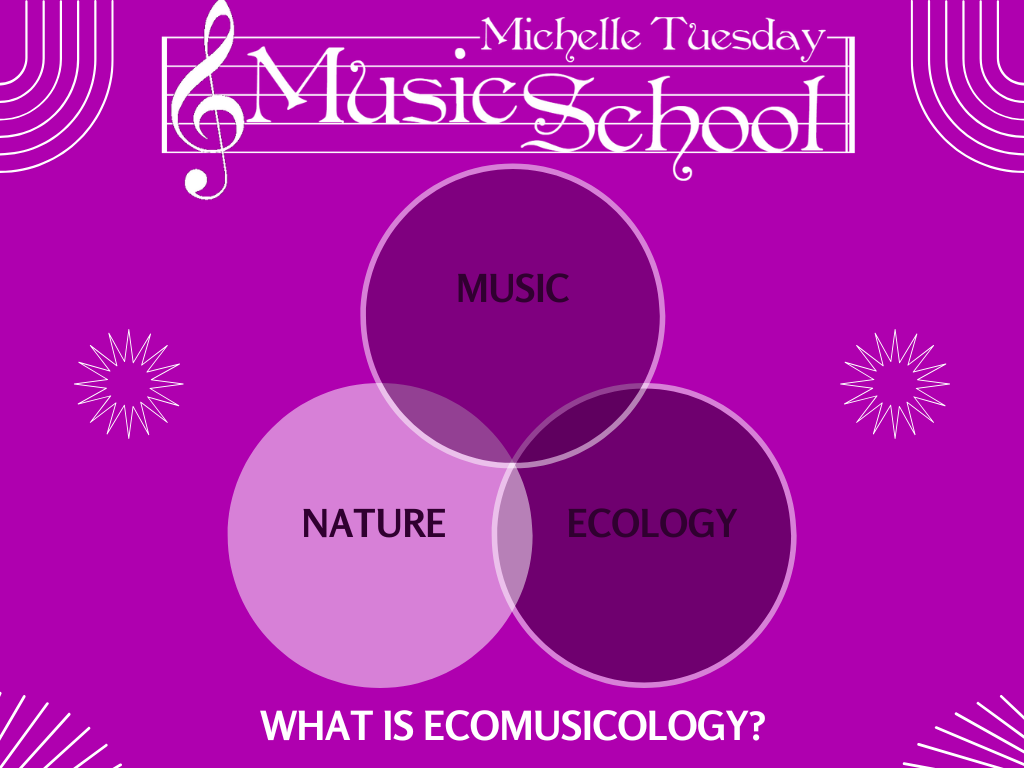
    Ecomusicology is a fascinating field where music and the environment meet. Put simply, it studies how music relates to nature and ecology. In addition, it considers how culture, sound, and the environment influence one another. For example, scholars examine how natural soundscapes shape music and listening. Therefore, ecomusicology goes beyond traditional music study. Instead, it blends musicology with ecological awareness and cultural analysis.

    Where the Idea Came From

    However, the idea did not emerge overnight. Its intellectual roots reach back to the late twentieth century. Soundscape studies played an important role in its early development. Meanwhile, scholars began using the term more widely around the year 2000. Today, ecomusicology draws from music, ecology, anthropology, and biology.

    What Ecomusicologists Study

    Ecomusicologists study a wide range of topics. First, they explore natural sound and its musical relationships. Second, they examine how people express environmental ideas through music. For example, songs about nature or environmental loss fit this area of study. In addition, they analyze field recordings used in musical composition. Moreover, they consider how performances and music production affect the environment.

    Why Ecomusicology Matters

    This field matters because environmental challenges affect communities worldwide. As a result, understanding sound and sustainability has growing importance. Music can raise awareness and encourage reflection. In turn, listeners may develop stronger connections to the natural world. Also, ecomusicology supports interdisciplinary learning and creative thinking.

    Ecomusicology in Practice

    In practice, ecomusicology appears in classrooms, studios, and performance spaces. In educational settings, it links music study with ecological ideas. Students may create compositions inspired by natural sounds. Likewise, listening activities often focus on soundscapes and place. Ultimately, ecomusicology helps people hear the world more thoughtfully.